

What is leukemia?
Leukemia is a type of blood cancer. The term leukemia comes from Greek words, which mean white blood (leukos “white”, haima “blood”):
Blood consists of liquid and cellular parts. The majority of blood cells are produced by stem cells in bone marrow. Bone marrow is a soft, spongy tissue found inside most bones, and it’s the site where blood cells are produced. Stem cells are undifferentiated (a cell that has yet to develop into a particular cell variant), immature cells that can multiply and turn into specialized cells.
There are the three types of blood cells—red blood cells, white blood cells, and platelets. Red blood cells distribute oxygen to all tissue and organs, which is important for producing energy. Platelets have a main role in the clotting process. White blood cells fight against infections. They recognize abnormal cells (e.g., cancer cells) in the body and kill them.
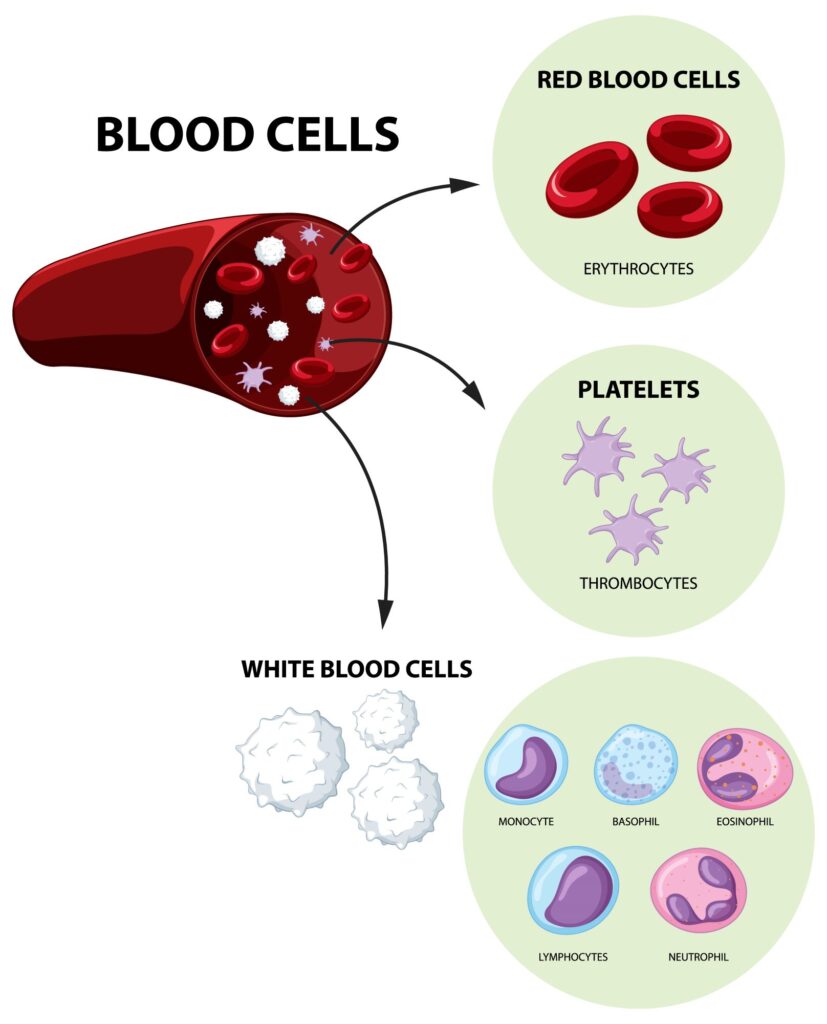
Leukemia develops when in bone marrow one of the stem cells mutates. A cell mutation is a change in the DNA sequence, and because of that, the cell acquires new properties. As a result, bone marrow starts to produce already changed white blood cells in a big quantity, which don’t have the ability to do their role and fight against infection. On the other hand, due to the overproduction of these cells, they use the whole resources of bone marrow and suppress the production of other cells – red blood cells and platelets. As the production of red blood cells is suppressed, the body’s tissues and organs do not receive sufficient oxygen, which leads to impaired function of these organs. Moreover, despite the increased number of white blood cells, which are non-functional, significantly increases the risk of developing infectious diseases.
Who can have leukemia?
Factors that may increase your risk of developing some types of leukemia include:
- Previous cancer treatment. Patients who received chemotherapy and radiation therapy for other cancers have a higher risk of developing leukemia.
- Genetic disorders. There are some types of genetic disorders, which are associated with increased risk of getting leukemia. For instance, people who have Down syndrome have a high risk of developing leukemia.
- Exposure to chemicals. Some kinds of chemicals, such as benzene (found in gasoline), which are widely used in the chemical industry, are carcinogenic (a substance, organism, or agent that can cause cancer) and increase the risk of developing leukemia.
- Smoking. Smoking cigarettes increases the risk of acute myelogenous leukemia.
- Family history of leukemia. If members of your family have been diagnosed with leukemia, your risk of the disease may be increased.
What types of leukemia are there?
Classification of leukemia based on its speed of progression and the type of cells involved.
By speed of disease progression
- Acute leukemia: the leukemia cells divide rapidly, and the disease progresses quickly. If you have acute leukemia, you’ll feel sick within weeks of the leukemia cells forming. Acute leukemia is life-threatening and requires immediate initiation of therapy. Acute leukemia is the most common cancer in children.
- Chronic leukemia: the leukemia cells divide slowly. Symptoms can develop several years later. Chronic leukemia is the most common in adults.
By cell type
- Lymphocytic or lymphoblastic leukemia develops from lymphoid cells. Normal lymphoid cells develop into white blood cells that are an important part of your body’s immune system.
- Myelogenous leukemia. This type of leukemia affects the myeloid cells. Myeloid cells give rise to red blood cells, white blood cells, and platelet-producing cells.
Types of leukemia
There are four main types of leukemia:
| Cell type | By speed of disease progression | |
| Acute | Chronic | |
| Myelogenous leukemia | Acute myelogenous leukemia (AML) | Chronic myelogenous leukemia (CML) |
| Lymphocytic or lymphoblastic leukemia | Acute lymphocytic leukemia (ALL) | Chronic lymphocytic leukemia (CLL) |
| Type | Statistics | Prevalence |
| AML | Both adults and children | 80% |
| CML | Common among adults over 65, rare in children | 90% |
| ALL | Common in children | 33% |
| CLL | Commonly affect over 65 age | 30% |
Symptoms
Symptoms depend, in part, on the type of leukemia.
Common signs and symptoms of leukemia include:
Fatigue, tiring easily.
- Fever or night sweats.
- Frequent infections.
- Shortness of breath.
- Pale skin.
- Unexplained weight loss.
- Bone/joint pain or tenderness.
- Pain or full feeling under your ribs on the left side.
- Swollen lymph nodes in your neck, underarm, groin or stomach, an enlarged spleen or liver.
- Bruising and bleeding easily, including nosebleeds, bleeding gums․
How is leukemia diagnosed?
Results from routine blood work can alert your healthcare provider that you may have an acute or chronic form of leukemia that requires further testing. Diagnostic exams and tests may include:
Physical Exam
During physical examination physician will do a palpation of lymph nodes, liver and spleen. They may also observe gums for bleeding, examine skin and look for rashes. Rashes in these cases could be red, purple and brown.
Complete blood count (CBC)
This examination will help to determine whether there are abnormal levels of blood cells. It is typical for leukemia to have a higher amount of white blood cells and lower amount of red blood cells and platelets.
Blood cell examination
Flow cytometry and peripheral blood smear are additional tests.
Bone marrow biopsy (bone marrow aspiration)
Your healthcare provider may perform a biopsy if you have an abnormal white blood cell count. A long needle inserted into your bone marrow (usually in your pelvic bone) draws out fluid during the procedure. The fluid sample gets tested in a lab for leukemia cells. A bone marrow biopsy helps determine the percentage of abnormal cells in your bone marrow, confirming a leukemia diagnosis.
Imaging tests
If there are signs that leukemia has affected bones and/or other organs, physician will order chest X-ray, CT scan or MRI scan. The leukemia cells don’t show up on imaging.
Lumbar puncture
Physician may test a sample of spinal fluid to see if leukemia has spread to the spinal fluid surrounding brain and spinal cord.
How is leukemia treated?
The choice of treatment for leukemia depends on the leukemia subtype, the individual’s age and overall condition, and the extent to which the cancer has affected other organs or tissues. Common treatments often include a combination of the following:
Chemotherapy
Chemotherapy is the primary treatment method for leukemia. It works by using medications to destroy leukemia cells or stop them from growing. These drugs may be administered orally, injected into a vein or given as a shot under the skin. In most cases, a combination of chemotherapy medications is used to increase effectiveness.
Immunotherapy (biologic therapy)
This treatment involves the use of specific medications to strengthen the body’s natural defense mechanisms—the immune system—so it can better target and destroy leukemia cells.
Targeted Therapy
This approach uses drugs that are specifically designed to attack certain components of leukemia cells, such as abnormal proteins or genes, that contribute to their uncontrolled growth. Targeted therapies can work by blocking the multiplication of leukemia cells or by directly destroying them. Because these drugs focus on cancer-specific features, they tend to cause less damage to healthy cells. Common examples include monoclonal antibodies and tyrosine kinase inhibitors.
Radiation Therapy
This treatment uses high-energy rays or X-rays to destroy leukemia cells or stop their growth. The radiation is directed at specific parts of the body where cancerous cells are located, or sometimes the entire body is exposed to radiation. Whole-body radiation is typically done before a hematopoietic stem cell transplant.
Hematopoietic Stem Cell Transplantation (Stem Cell or Bone Marrow Transplant)
This treatment involves replacing the blood-forming cells that were destroyed by chemotherapy and/or radiation therapy with healthy ones. In some cases, it is possible to collect the patient’s own healthy stem cells before starting chemotherapy or radiation, to be transplanted back later. Alternatively, stem cells may come from a donor.
Chimeric Antigen Receptor (CAR) T-Cell Therapy
This is a modern and advanced treatment method. In this process, T-cells, which are immune cells that help fight infections, are taken from the patient’s body. These cells are then genetically modified to recognize and attack leukemia cells. After the modification, the T-cells are put back into the patient to help fight the disease.
What is the prognosis of leukemia?
The outcome of treatment depends on several factors, including
- Genetic abnormalities or mutations—One of the most important predictors of treatment outcome is the type of mutation present in the leukemia cells.
- Type of leukemia—Some types have a more favorable prognosis than others.
- Number of leukemia cells at the time of diagnosis
- Age—The younger the patient, the more favorable the prognosis.
- Overall health—The better the general condition of the body and the fewer the accompanying illnesses, the more favorable the outcome.
- Response to treatment—The quicker remission is achieved, the higher the chances of successful treatment.
- Presence of leukemia cells in the central nervous system (CNS)—If leukemia cells are found in the cerebrospinal fluid, treatment becomes more complicated.
How common is leukemia?
Leukemia is the 10th most common cancer in the U.S., accounting for 3.2% of all new cancer cases. Leukemia can affect anyone, but it’s more common among people who are:
- Ages 65 to 74.
- Male sex.
- Caucasian/white.
Many people think of leukemia as a pediatric cancer, but some forms develop more often in adults. Although leukemia is rare in children, it’s the most common form of cancer affecting children and teens.
What is the survival rate of leukemia?
The National Cancer Institute reports the following survival data for the four main types of leukemia:
| Types of Leukemia | ALL | AML | CLL | CML |
| 5-year survival rate* | 69.9% | 29.5% | 87.2% | 70.6% |
| Number of deaths per 100,000 persons | 0.4 | 2.7 | 1.1 | 0.3 |
| Death is highest among those aged | 65-84 | 65+ | 75+ | 75+ |
*Survival compares patients diagnosed with cancer vs. people of same age, race and sex who are cancer free.
Data source: SEER Cancer Statistics Review, 1975-2017, National Cancer Institute. Bethesda, MD.
Is a Complete Cure for Leukemia Possible?
Leukemia does not have a guaranteed cure. A complete cure means there are no leukemia cells left in the body and no further treatment is needed. In the case of leukemia, it is not possible to be certain that the disease will come back. The goal of treatment is to achieve long-term remission. In long-term remission, there are no signs or symptoms of cancer, either with or without ongoing treatment. Remission can last for weeks or even years. In some cases, permanent remission is possible.
When to see a doctor?
Make an appointment with your primary care provider if you have any persistent signs or symptoms that worry you. Leukemia symptoms are often vague and not specific. You may overlook early leukemia symptoms because they may resemble symptoms of the flu and other common illnesses. Sometimes leukemia is discovered during blood tests for some other condition.
Sources:
UpToDate
Mayo Clinic
Cleveland Clinic
Osmosis