Who is in the elderly age group?
The definition of ‘older’ or ‘elderly’ varies and is often debated. Typically, individuals are considered elderly when they reach 60 years of age or older. As healthcare delivery systems continue to improve, the number and proportion of older people in the population are increasing. In 2019, the number of people aged 60 years and older was 1 billion. This number will increase to 1.4 billion by 2030 and 2.1 billion by 2050.
What is aging?
Aging is a natural process. It is defined as a progressive loss of physiological integrity leading to functional impairment and an increased likelihood of death.
Aging affects every part of the human body and influences all of its functions.
- The heart contracts more slowly and more weakly, and over time, blood vessels become stiffer, thicker, and narrower.
- Kidney function diminishes. The bladder becomes less stretchy and cannot hold as much urine as before.
- The liver gradually loses its ability for toxin and drug metabolism.
- Lungs turn stiffer, breathing becomes harder, and oxygen levels in your body may lower.
- Brain functions decline, reflexes and sensation reduce, and processes of thinking and memory slow.
- Reduction of bone mass (osteopenia) and loss of muscle mass (sarcopenia) take place.
- The immune system reacts poorly to infections, healing processes become slower, and the risk of having cancer increases.
- Metabolism slows over time. Additionally, some tissues become less sensitive to hormones, and the production of hormones also changes with age.
Older people face various daily challenges, including social concerns, financial constraints, and limitations in mobility, cognition, and overall health.
What health conditions are associated with aging?
Natural aging processes of the human body tend to lead to diverse chronic conditions. The term “chronic” means that these problems are long-lasting and require ongoing medical attention. Here is the list of common ones.
- Arthritis or chronic pain
- Heart and blood vessel diseases: high blood pressure, orthostatic hypotension (low blood pressure), high cholesterol, atherosclerosis, coronary artery disease, heart failure, abnormal heart rhythms, anemia, heart valve diseases, transient ischemic attacks (TIA), blood clots, deep vein thrombosis, varicose veins, etc.
- Cancer
- Chronic pulmonary disease
- Alzheimer’s disease
- Dementia
- Osteoporosis
- Diabetes
- Sleep apnea
- Kidney and bladder diseases: urinary incontinence, urinary tract infections, and chronic kidney disease.
- Depression and anxiety
The risk of acute diseases and injuries is also increased. In contrast to chronic problems, these are usually short-term and treatable. Some common acute health conditions of older people are:
- Pneumonia
- Bronchitis
- Sinusitis
- Flu
- Appendicitis
- Heart attack
- Stroke
- Sprains and broken bones
Why do the elderly have special medical needs?
Elderly patients differ significantly from younger adults; thus, medical care is also unique and challenging. Factors influencing elderly health management include, but are not limited to, multimorbidity, polypharmacy, cognitive decline, and other age-related conditions.
Multiple chronic conditions (multimorbidity)
Typically, multiple chronic conditions coexist. As a consequence, diseases may interact and exacerbate each other. These processes make diagnosis and treatment more difficult.
Taking multiple medications (polypharmacy)
Older people often take multiple medications (commonly five or more). Drugs may interact with each other and with diseases. This leads to an increase in the likelihood of adverse drug reactions.
Age-related physiological changes
As mentioned above, the aging process leads to age-related physiological changes. This transformation increases the risk of several diseases and leads to cognitive and functional decline.
Cognitive decline and sensory impairments
As with other age-related processes, cognitive decline is also a natural process that accompanies aging. Normal age-related cognitive decline, also known as cognitive impairment, is mild and slow. Your thinking abilities may decline, and you may have difficulties sustaining attention, multitasking, holding information in mind, and word-finding. In abnormal aging, decline is more severe and may lead to dementia, delirium, and depression.
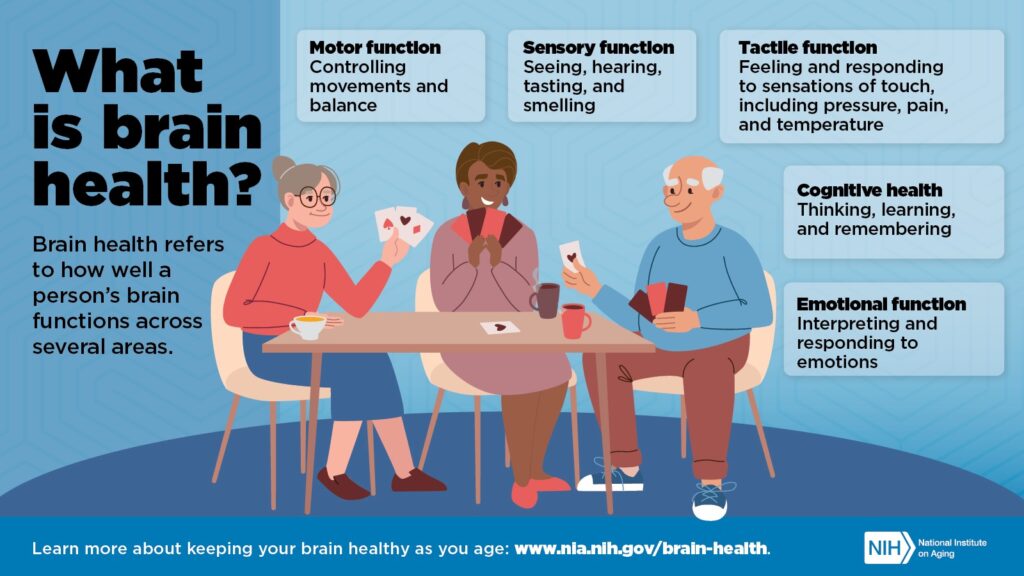
Image source: National Institute of Aging
Sensory impairments also contribute to further deterioration of cognitive functions. With global aging, sensory impairments such as hearing and vision loss have become increasingly common. Research indicates that roughly one-third of adults over 65 live with a significant degree of sensory impairment.
A decline in cognition interferes with treatment effectiveness, reduces adherence to medical care, and increases the burden of the caregiver.
Functional decline
Functional decline refers to a reduced ability to perform daily activities and self-care due to physical and cognitive limitations. Moreover, when multiple health conditions are present, they often result in greater disability than expected. That’s because the patient’s ability to compensate for one problem may be affected by other health conditions.
Frailty
Frailty is a common clinical syndrome in the elderly. It’s characterized by a decline of physical and cognitive reserves. This leads to increased vulnerability to stressors. Frailty is associated with unexpected weight loss, exhaustion, weakness, slow walking speed, low physical activity, and unintentional falls and injuries. These lead to longer hospitalizations, difficulty recovering from illnesses and surgeries, and higher mortality.
Who treats elderly?
Older people may consult a variety of healthcare professionals: family practice doctors, general internists, and specialists (such as cardiologists). Also, they could refer to geriatricians. Geriatricians are doctors, usually family practice doctors or internists, who are specialized in the healthcare needs of the elderly. Depending on your medical history or needs, you may see a geriatrician, or you’ll likely still work with your primary care physician.
Sources:
WHO
Weill Institute for Neurosciences
National Institute of Aging
American Geriatrics Society
Pasadena Health Center